Monday, 11 September 2017

Exam Structure Changes: New Curriculum

The Exam Structure will slightly change for the new curriculum. As I highlighted few years back that Zimsec is likely to follow the IGSCE exam structures, there has been a change in the structure and it will be similar to Cambridge's Mathematics Syllabus D.

The first paper will remain unchanged but in the Second paper, compulsory questions will be five (5) and four (4) optional questions from seven (7) questions in section B. The new curriculum syllabus don't specify the optional topics but the total questions for Paper 2 will remain 12.
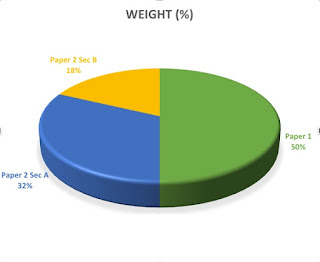
This is likely to make mathematics exam easy since there will be a lot of questions to chose from and one can easily concentrate on specific areas to maximize the total score. However, the specific Section B areas will be known after 3 to 5 years as teachers will begin to identify the pattern of the new system.

The Exam will contribute 70% to the final score and 30% will come from coursework and projects from Junior Certificate and Ordinary Level. If candidates maximize their marks in coursework, they will need 30 to 50% to obtain grade C or better.

In the next post I will highlight some changes to the content of the syllabus. 

Thursday, 7 September 2017

New A Level Pre-requisites

Many students used to decide on their A level combinations after collecting O Level results and it wasn't a topic to discuss at Form Three. You could even study Subjects that were not part of your O Level collection, like Economics, Business Studies and Divinity.

Now , the New Curriculum requires that students chose their combinations at Form Three. A Level subjects have O Level prerequisites which are added to the 7 compulsory subjects. This implies you must sit for at least 10 subjects if you are planning to study A Level. For example, you can't study A Level Pure Maths with General Mathematics as was before.
To study..,
Pure Mathematics, you need Pure Mathematics at O Level. Same goes with 
1. Statistics
2. Economics 
3. Business Studies 
4. Mechanics 
5. Accounting 
6. Biology
7. Chemistry 
8. Physics 
9. History 
10. Geography
11. Divinity
12. English Literature


These are all optional subjects at O Level and you must exhibit competence in these subjects at O Level if you are to continue with the same at A Level.

However, most poor schools and rural schools will be affected as they will prioritize other subjects which might not be preferences of all students due to staff shortage. Some might chose not to study Pure Mathematics but focus on General Mathematics, some chose to concentrate only onCombined science and ignore pure Science subjects. 

This means students cannot study Medicine or Accounting at Tertiary Level not because they don't have passion or failed the subjects but because their schools were not offering the prerequisites as options at O Level. 

Given the above, it implies that passionate students will find ways to study other subjects which are their preferred A Level Combinations, however there is need to find a teacher who will carry on the continuous assessment of their projects and course work. 

Another Important thing to note is that: A Level combinations are now affected by these developments as students can study Pure Mathematics, Statistics and Mechanics as a combination or chose Statistics, Accounting and Business Studies. 


NEW CURRICULUM COMPULSORY SUBJECTS

With only 14 months left for the first New Curriculum Exams, it's important for next years candidates to acquaint themselves with the prerequisite of the exam.

New curriculum introduced a coursework which contributes 30% of the Exam and Final Exam contributes 70%. A coursework includes
- major termly tests
- monthly tests
- projects
This means only formally registered schools with qualified staff are suitable for the process.

There are 7 compulsory subjects to be registered by every candidate
1. Mathematics (General Maths)
2. Combined Science
3. English
4. Heritage Studies
5. Physical Education
6. Indigenous languages
7. Agriculture

However these subjects don't have A Level options, which means students who want to study A Level must add 3 more subjects as their A Level prerequisite subjects

We will discuss more on A Level prerequisite in the next posts

Thursday, 15 June 2017

EXAM ORIENTED EBOOKS for ZIMSEC MATHEMATICS

Zimbabwean students and candidates rely much on textbooks to prepare for the Exam and the most popular book series are the New General Mathematics Book 3 and Book 4. However, the syllabus continues to be updated frequently than the textbook, making recent textbooks better in terms of content tested by the Examination.

The major mistake candidates make is to assume New General Mathematics Book 3 and 4 have all the exam areas needed for someone to be successful on the final examination. You might have noticed that more than 7 or 8 questions from paper 1 are not covered in these books and examples includes Whole Numbers (Prime products, Roots and Squares, Series and Sequency etc), Distance Charts, LCM and HCF of index numbers. Most of these principles are covered in the Books 1 and 2, which makes them a need to the collection if you are to go with the NGM book series. All topics are essentially covered from Book 1 up to 4.

The major determinant of success especially at Ordinary Level is the ability of the teacher to interpret the latest syllabus and organize content from different textbooks and sources into exam oriented lessons. To be frank, a good teacher makes a textbook unnecessary for students since they have what it takes to score an 'A' from the teachers stuff. 

In Zimbabwe, shortage of textbooks affected most schools until EFT provided adequate textbooks and resources in schools since 2009. The textbook:pupil ratio in now as good as 1:1 but still the pass rate fluctuates between 20% to 35% yearly. Surprisingly, some schools mantain a 100% pass rate in Mathematics. This apparently shows it's the strategy and the experience of the teachers at those specific schools. 


Many students and teachers are now using technology to gather, share and organize resources that aid in studying for the final examinations. However, we are yet to see an official past paper from Zimsec in PDF format, or any textbook published as an ebook for Zimbabwean candidates. That will obviously ease the journey and yield better results as more students and candidates access recent and updated content that match syllabus requirements.


At FigTree Academy, we are now publishing ebooklets on critical topics to aid students in their studies. The ebooks are organized in lessons and only focus on specific concepts enunciated by the syllabus. The ebooklets are for FREE and published continually until all topics are covered. The ebooks are being authored by practicing teachers who also prepare video content for our android app called FigTree App.

There are now 7 ebooks that cover 10 topics including Transformations, Functional graphs and Circle Geometry. The ebooks are well illustrated and strives to demystify some areas of most challenging topics. 


All the concepts are explained using past exam questions that are organized under specific sections. There are meant to be a complete guide alongside video content. Students can easily understand the ebook content by reading whilst watching a video explaining the same concept. All on your mobile phone!


To access the ebooks, WhatsApp +263 733 796 118


Friday, 14 April 2017

FigTree App: Data Friendly and Fast

One of the major reasons why FigTree academy App got more downloads in less a week of launch are the features. Unlike other educational apps that are ad based and always need Internet connection to access the contents, FigTree have no ads and contents can be viewed offline once downloaded. 

There are video lessons for about six subjects in the app that were unlocked last week. Core subjects offered through the App includes English language, Geography, Accounting, Commerce, Intergrated Science and Mathematics. The content providers currently concentrate on Ordinary Level Stuff and will launch lessons for other levels by the end of the year. The content is being prepared by qualified and experienced teachers.

You don't need much data to get the videos. FigTree app offers a download option and saves your videos in order within the app. The next you want to view your lessons, there is no need for data once lessons are downloaded. Some of the lessons will be around 540kb up to 5mb per lesson. This makes the app more data friendly. 

The lessons are arranged in topics, with 7 videos per topic on average. More complex topics have 13 video lessons and simpler topics have 4. You can have a monthly package of 4 topics and the lessons need less than 50 mb, which will cost you around 50cents or less.

There are other features that will make  FigTree similar to a traditional classroom. You have WhatsApp support of tutors, you can submit you exercises in the app and receive instant feedback, explanation and corrections. There are student groups also 

You can get the app on Google play or apk file on different sites. WhatsApp +263 733 796 118 for assistance and further explanation.